
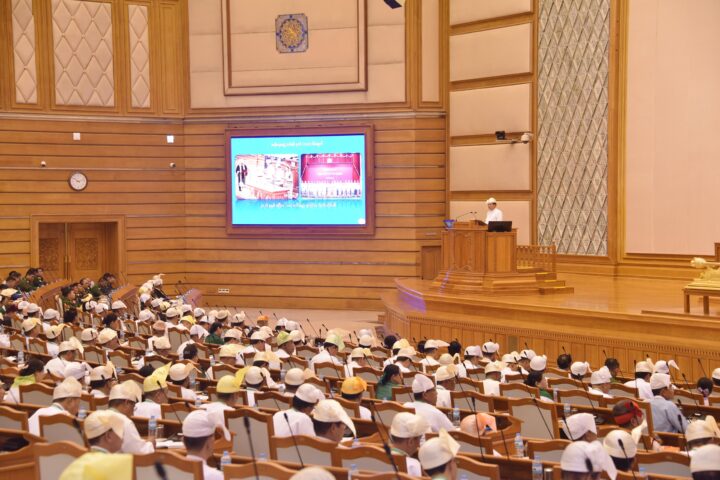
As the Pyidaungsu Hluttaw of the Republic of the Union of Myanmar had delivered a message of invitation, President of the Republic of the Union of Myanmar U Min Aung Hlaing delivered an address emphasizing the report on 100-day progress of the government under Section 210 of the Constitution and Section 65 of the Pyidaungsu Hluttaw Law at the 12th-day meeting of the Second Regular Session of the Third Pyidaungsu Hluttaw at 10 am yesterday.
The Pyidaungsu Hluttaw was attended by 539 out of 560 lawmakers, accounting for 96.25 per cent.
Pyidaungsu Hluttaw Speaker U Aung Lin Dwe invited President U Min Aung Hlaing of the Republic of the Union of Myanmar to address the Hluttaw on the government’s 100‑day progress. The President delivered his remarks on the State’s advancement. He said:
The government has, since assuming office, accelerated the implementation of its two priority objectives: ensuring national peace and stability and promoting the country’s development. Only when the country is peaceful and stable can the socioeconomic well-being of the people and the national economy be effectively developed.
With regard to peace, the government stated that during its first 100 days in office it had intensified efforts to encourage those who had taken up arms due to political differences to return to the legal fold and engage in peaceful dialogue. It also reaffirmed that the door to peace has been kept permanently open and that all parties have been continuously invited to participate in the peace process.
The government stated that, intending to establish a Union founded on democracy and a federal system – the shared aspiration of all ethnic nationalities – it has submitted to the Pyidaungsu Hluttaw a package of 43 proposed amendments to the 2008 Constitution. The government also stated that it has consistently invited all Ethnic Armed Organizations (EAOs) to engage in dialogue and that it has so far held discussions with 13 EAOs.
At this time, all ethnic nationalities need to unite and work together in building a new nation. To restore peace and stability across the country as soon as possible, the government emphasized that, in the peace process, rather than insisting on demands that are unattainable, all parties should negotiate and pursue only those objectives that are realistic, achievable, and in line with the current circumstances.
The responsibility for achieving lasting peace does not rest solely with the government. Rather, it is a shared responsibility of all national institutions, including the government, the Tatmadaw, and the Hluttaw. Therefore, it earnestly called on all stakeholders to cooperate to the fullest extent of their abilities in the collective effort to achieve enduring peace throughout the country.
Regarding national defence, the government stated that the Tatmadaw will be developed into a modern, standard army with strong combat capability and power. It further stated that, to ensure broad public participation in national security and defence, a people’s militia strategy will be implemented under the leadership of the Tatmadaw.
The government also noted that while responsibility for internal security rests with the Myanmar Police Force, the current situation in the country has required the Tatmadaw to work jointly with the police in addressing internal security challenges. Systematic training will be provided to further enhance the professional capabilities of police personnel in order to strengthen internal security and uphold the rule of law.
In safeguarding and promoting Myanmar’s national interests, the government stated that it will adhere to the foreign policy enshrined in the Constitution – an independent, active, and non-aligned foreign policy – and pursue balanced and well-proportioned relations in its international engagements. Myanmar will continue to strengthen its international relations with neighbouring countries and regional partners in accordance with the Five Principles of Peaceful Coexistence.
Regarding the current situation within ASEAN, the government noted that although some ASEAN member states had, over the past five years, adopted positions and practices that it regarded as discriminatory towards Myanmar, Myanmar had exercised patience and continued to cooperate in accordance with its responsibilities as an ASEAN member state.
The government further stated that it would respond to any discriminatory actions that are not constructive on a case-by-case basis, as necessary. In line with the country’s foreign policy, the government said it would base its actions on prevailing realities while safeguarding Myanmar’s national interests and sovereignty, and would work to enhance relations with ASEAN through a Myanmar-led, Myanmar-owned approach.
The present time is a crucial period in which agriculture, livestock breeding, and industrial economic sectors – the fundamental pillars for improving the socioeconomic development and livelihoods of the people – must be promoted in a balanced and integrated manner. Myanmar already has a sufficient amount of agricultural land, and therefore there is no need to further expand cultivated areas. Instead, it is necessary to shift from traditional farming systems to modern mechanized agriculture in order to achieve targeted yields, increase multiple cropping, and enhance overall productivity.
The government stated that it will ensure that paddy is cultivated across all agricultural lands to achieve the targeted yield, enabling not only domestic food sufficiency but also restoring Myanmar’s previous status of exporting rice in large volumes. In addition, in line with the vision of ushering in a new era for Myanmar’s Pawsan rice, the government is taking measures in the first phase to expand the cultivation and production of high-quality rice varieties that meet market requirements, to export three million tonnes of rice annually. It is also implementing plans to expand paddy cultivation by an additional 350,000 acres with suitable varieties. In the second phase, the government aims to increase annual rice exports to five million tonnes. Furthermore, Myanmar is striving to become one of the world’s major food-producing countries and a “rice bowl” nation, not only supplying regional countries but also contributing to global food security.
Regarding domestic edible oil sufficiency, the government stated that special zones have been designated for oilseed crops such as groundnut, sesame, and sunflower in 12 areas, with measures being implemented to increase per-acre yields and achieve targeted production levels.
As edible oil has to be imported from abroad, a large amount of foreign currency is being spent. A total of 550,000 tonnes was imported in 2024 and 640,000 tonnes in 2025. At present, around 550,000 acres of various cotton varieties are being cultivated, and plans are underway to increase cotton cultivation and production to 600,000 acres in the 2027-2028 crop season. If current cotton production and cultivated acreage are maintained at the proper levels, there will be a large surplus, enabling exports to foreign markets. Currently, cotton yield averages only 499 viss per acre. Therefore, if efforts can be made to increase the yield to the target level of 700 viss per acre, significant foreign exchange earnings can be generated. Accordingly, measures will be taken to encourage and support increased cotton production. Solar-powered river water pumping projects have also been initiated to ensure an adequate supply of irrigation water, which is essential for agricultural activities.
Based on the annual consumption rate of the population of 51.4 million people, it has been found that in most regions and states, the production of chicken and pork, as well as basic food items such as chicken eggs and duck eggs, is insufficient to meet local demand. The significant gap between consumption and production has also contributed to high commodity prices.
Therefore, it is necessary to further promote and expand the livestock sector to ensure food sufficiency. At present, Myanmar’s actual fish production consists of 30 per cent from aquaculture and 70 per cent from capture fisheries. It has been found that the aquaculture sector remains far lower than that of neighbouring countries in the region.
In 2024, the price of crude oil was around US$84 per barrel, while in 2025 it was around US$72 per barrel. Following the outbreak of conflicts in the Middle East in 2026, the price of crude oil rose to as high as US$126 per barrel. As a result, production costs for all businesses dependent on fuel have increased significantly.
As Myanmar imports fuel worth around US$5 billion annually, it is necessary to implement fuel-saving measures as a national policy to ensure energy security and overcome these challenges. Fuel consumption has been reduced by implementing measures such as allowing vehicles to operate on designated odd and even days and introducing work-from-home arrangements on Wednesdays. Through these fuel-saving measures, approximately 1.2 million gallons of fuel have been saved per day, resulting in savings of about US$7 million per day and around US$210 million per month. To date, total savings have exceeded US$1 billion. Appreciation is also extended to the public for their cooperation and participation in these efforts.
Furthermore, the government is accelerating the upgrading of the railway sector in order to reduce dependence on fuel. To promote fuel conservation, battery electric locomotives (BELs), which use battery systems as an alternative to fuel, have been converted, modified and manufactured domestically, and some of them have already begun operating on certain railway routes. At present, the use of BELs is considered one of the best solutions for reducing fuel consumption and minimizing environmental impacts. Therefore, efforts are being made to continue promoting the use of BEL locomotives until electric railway systems can be fully introduced and utilized. Similarly, in the automotive sector, special emphasis is being placed on promoting the replacement of petrol and diesel-powered vehicles with electric vehicles (EVs).
Similarly, efforts will be made to improve waterways so that the Ayeyawady River and the Chindwin River can be effectively utilized throughout the year for cost-efficient waterway transport. In the aviation sector, five airlines are currently operating with a total fleet of 32 aircraft. Within the first 100 days, 10 projects have been successfully implemented, including runway upgrades and maintenance works at Anisakhan Airport in PyinOoLwin’s Township, Mandalay Region, as well as at Kawthoung, Myeik, Dawei, Pathein, Bagan-NyaungU, Kengtung and Tachilek airports, to enable passenger jet aircraft to land at these airports.
We are also conducting studies on the construction of low-head dams and power plants along the main Ayeyawady River. If the 10 electricity projects, including the Myitsone Project, can continue to be implemented, the required amount of electricity for the country will be fully supplied. Therefore, efforts will be made to implement these projects to improve the socioeconomic living standards of the people.
In seeking various ways to generate the electricity required for the country, coal-fired power generation and nuclear power generation are also options that need to be considered. In order to achieve the goal of nationwide electricity access by 2030, Myanmar will construct an advanced-technology coal-fired power plant with a capacity of up to 660 megawatts, designed to minimize environmental impacts, in phases over five years to contribute to the national power supply plan. In addition, efforts will continue toward the construction of a nuclear power plant.
Looking at the education situation in Myanmar, the literacy rate among the population aged 15 and above was 92.1 per cent in 2024, while the numeracy rate was 92.3 per cent. To promote the development of the education sector, 6.92 per cent of the State budget will be allocated to the Ministry of Education in the 2026-2027 FY. Including education-related expenditures of other ministries, a total of 9.22 per cent of the State budget will be spent on the education sector. In the upcoming 2027-2028 FY, the allocation for the Ministry of Education will be increased to no less than 10 per cent of the State budget. Furthermore, plans are being made to increase education sector expenditure to 15 per cent of the State budget in the 2028-2029 FY.
According to the current statistics of the Ministry of Education, in the 2026-2027 academic year, approximately 4.9 million students are attending primary schools, more than two million students are attending middle schools, and over 600,000 students are attending high schools, bringing the total number of basic education students to more than 7.5 million.
Compared with the 2025-2026 AY, when the total number of basic education students was over 7.1 million, the number of students has increased by around 400,000 this year. However, when compared with the 2016-2017 AY, when the number of students attending schools was 9.4 million, the current figure remains lower. Therefore, continued efforts will be made to ensure that every school-age child has the opportunity to attend school.
Special programmes will be implemented in areas with weaker education systems to enable students to continue their education up to KG+9 level. In addition, 92 industrial, agriculture and livestock high schools have already been opened. Among the 15 existing agricultural and livestock breeding institutes, plans are currently underway to upgrade the schools in Pwintbyu, Thayawady, Thaton and Heho, which have suitable school areas and basic infrastructure, into agricultural and livestock breeding colleges, and to appoint the necessary teachers and staff.
In the education sector, out of a total of 50,962 basic education schools, 35,539 schools have been opened. Of the 50 universities under the Department of Higher Education of the Ministry of Education, 48 have been reopened. There are currently 315,285 teachers serving at the basic education level and 10,679 lecturers and staff serving at the higher education level. Among the 25 Education Degree Colleges, five are being upgraded to universities specializing in teacher education. In addition, 8,000 teachers whose appointments had been delayed for various reasons have been appointed during this month.
In the basic education sector, the Smart School programme and the Football for Schools Programme were also implemented in coordination with the Ministry of Sports and the Myanmar Football Federation during the government’s first 100 days. Furthermore, construction of convocation halls, recreation centres, standard football fields and sports halls is also being carried out at major universities in various states and regions.
Preparations have already begun to develop human resources and the necessary technologies to launch a Myanmar-owned satellite in cooperation with China in the near future. Nano Satellites and Micro Satellites will also be jointly developed and launched in collaboration with partner organizations. Myanmar’s life expectancy at birth was only between 60 and 64 years at the beginning of the 30-year long-term Myanmar Health Vision plan in 2000. It is projected that life expectancy will increase to between 75 and 80 years by 2030.
Therefore, the government has upgraded and opened 15 nursing and midwifery training schools as nursing institutes. The remaining 27 nursing and midwifery-training schools have also been prioritized for organizational upgrading. In addition, plans are underway to recruit approximately 1,200 newly graduated doctors and around 2,600 newly graduated nurses by the end of 2026. In the health sector, 200-bed hospitals in various states and regions are being upgraded to 300-bed hospitals, while medical equipment and supplies are also being provided and supplemented.
According to the 2024 census, Myanmar has a youth population of around 17 million, accounting for 32.69 per cent of the total population. Therefore, having a large young population is a golden opportunity for the country. Despite this great opportunity, the high school dropout rate among young people has resulted in weaknesses in education, including limited access to higher education, vocational education and digital technology skills. The government has adopted the theme “Empowered Youth, Strong Nation, Shared Future” as its vision for youth sector development. It is committed to formulating a National Youth Development Policy Framework and developing and implementing strategies as well as short-term and long-term plans for youth development.
According to the 2024 Census Report, women account for approximately 53 per cent of Myanmar’s population. The representation of women in the Pyidaungsu Hluttaw (Union Parliament) increased from 4.8 per cent in the first term to 10.5 per cent in the second term, and further increased to 14.6 per cent in the third term. Similarly, the proportion of women holding senior positions at the level of director-general and above within government organizations has increased to 51.5 per cent. In addition, the government has established and assigned a dedicated Ministry of Women’s Affairs to further enhance the capacity and capabilities of Myanmar women in various fields.
The government will emphasize promoting public-private partnerships (PPP). It should also be noted that strengthening research and development and ensuring policy stability will help enhance private sector confidence and encourage investment. Myanmar is situated at the centre of a region with a population of around four billion people and has great potential in terms of economy and trade. Therefore, to promote national economic development, it is necessary to expand the export sector while also strengthening the domestic production sector to substitute imports.
One of the factors contributing to the trade deficit is the low level of domestic production combined with a high volume of imports. In addition, monetary, fiscal, trade and investment policies will be reviewed and studied, and measures will be accelerated to promote the development of the economic sector.
According to the 2024 Population and Housing Census, the labour force participation rate among the population aged 15 and above was only 47 per cent. In addition, among those who migrated abroad, the age group of 15 to 34 years accounted for approximately 71.7 per cent of all migrants. Therefore, we are placing special emphasis on implementing the India-Myanmar-Thailand Trilateral Highway Project. Efforts are being made to ensure its full completion during the term of the current government.
In addition, the Mandalay-Muse Railway Project, which is a key project under the Belt and Road Initiative (BRI), will serve as a vital lifeline opening up Myanmar’s northern economic gateway. It will greatly enhance Myanmar-China trade and economic cooperation. If the country enjoys stability and peace, development activities can be carried out without disruption. Myanmar’s current forest coverage accounts for 42.15 per cent of the country’s total land area. As a long-term plan to restore forest coverage to 50 per cent of the country’s territory, the policy “Let us conserve the environment for the prosperity of the nation” has been adopted and is being implemented.
Regarding the tourism sector, countries around the world regard tourism as a “smokeless industry” and rely on it as an important economic sector. Myanmar has favourable resources for tourism development, including national heritage sites, ancient Buddhist pagodas and monuments that have contributed to Myanmar being described as the “Golden Land”, as well as the Myanmar Thingyan Festival, which is the first intangible cultural heritage of the Myanmar people representing humanity. Efforts are being made to effectively utilize these resources and develop nature-based and cultural tourism in the best possible manner.
Since the 2024-2025 AY, law studies have been introduced at the upper secondary education level. As a result, around 800,000 high school students have already gained basic knowledge and understanding of law. In particular, instructions have been issued to strictly address and take effective action against drug prevention and suppression as well as online scam and online gambling activities in various regions and areas.
The government considers online fraud and online gambling as serious crimes committed against the majority of people. Therefore, the government will not tolerate or condone such activities and is taking strong measures to suppress and eliminate them. During these crackdowns, it was found that 99 per cent of the offenders were foreign nationals who had illegally entered Myanmar through neighbouring countries to carry out such activities. However, foreign media outlets have been portraying the issue in international news reports as if Myanmar alone bears responsibility for these crimes.
The government considers narcotic drugs, which can destroy humanity, as a national threat. Therefore, it regards the fight against narcotic drugs as a national responsibility and has been carrying out prevention, control and suppression measures against drug production and illegal trafficking with strong commitment, determination and continuous efforts. The narcotics trade is a major source of income for some armed groups claiming to be EAOs, and it remains a key business activity that they are unwilling to abandon. As a result, drug production and trafficking activities are still being carried out to date. We will continue to conduct effective intelligence operations and take necessary action to suppress these activities.
In conclusion, the 100-day period since the government assumed responsibility has been a historic period during which solid foundations for the future of the nation have begun to be established. We are moving forward rapidly in all sectors while upholding two priority objectives: “achieving stability and peace in the country” and “achieving national development”.
The government will build a new Union nation based on democracy and a federal system in accordance with the aspirations of the people. I would like to urge everyone not to be left behind in terms of thoughts and perspectives. I will take two years to lay the groundwork and gain momentum for building the new nation, and a further three years will be devoted to carrying out rapid development and construction efforts. I earnestly urge the entire people to actively participate and provide support together with us in all sectors for the development and construction of the nation.
Also present on the occasion were Vice-Presidents U Nyo Saw and Nan Ni Ni Aye, Pyidaungsu Hluttaw and Amyotha Hluttaw Speaker U Aung Lin Dwe, Pyithu Hluttaw Speaker U Khin Yi, Chief Justice of the Union U Tha Htay, Commander-in-Chief of Defence Services General Ye Win Oo, the State dignitaries, speakers of region and state Hluttaws who are members of the Myanmar Parliamentary Union, deputy ministers, lawmakers, observers from the basic diplomatic skill course 47/2026, and other 150 guests together with chief ministers of regions and states through videoconferencing.
After leaving the Pyidaungsu Hluttaw convention hall, the President responded to questions raised by the media.
Pyidaungsu Hluttaw Speaker U Aung Lin Dwe sought the Hluttaw’s approval for the President’s report on the government’s 100‑day progress and formally entered it into the record.
An honorary luncheon to mark the successful completion of the Second Regular Session of the Third Hluttaw was held at the dining hall of the Hluttaw Complex. The President and those who attended the meeting had lunch together.
After the luncheon, the President cordially greeted the attendees.
MNA/TTA
#TheGlobalNewLightOfMyanmar