
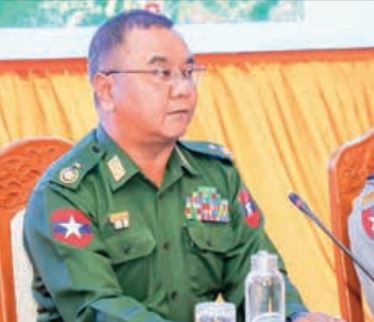
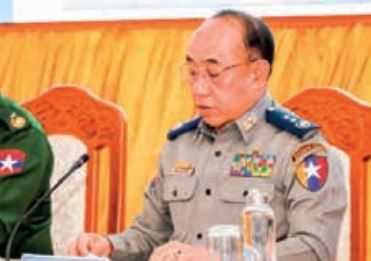
THE second press conference on the largest seizure of narcotic drugs and materials used in drug production was held at the Anisakhan Airfield in PyinOoLwin yesterday morning.
National Defence and Security Council’s Information Team Leader and Deputy Minister for Information Maj-Gen Zaw Min Tun extended greetings to diplomats, military attaches and media personnel. Next, he briefed them on the seizures of narcotic drugs and materials used in drug production in the second press conference. He said: At the first press conference, the first press briefing was held on seizures of narcotic drugs and equipment used in drug manufacturing at this site. Subsequently, during a more thorough search and combing operation in the surrounding area, additional manufacturing sites and large quantities of materials were seized in a second operation. That is why further combing work was carried out. During the first operation, members of the media and diplomats had already visited the site. Locations that had been visited during the first round were shown again, after which all seized items were destroyed by burial or burning. After today’s press briefing, the sites where materials were destroyed by burial and burning will be shown from above by helicopter during the return trip. In addition, the sites seized during the second operation will also be shown during a field visit. First, I will introduce the officials attending this press conference. I am Maj-Gen Zaw Min Tun, Deputy Minister and Information Team Leader of the National Defence and Security Council. This is U Ko Ko Kyaw, Deputy Minister for Foreign Affairs. Over here is Chief of Myanmar Police Force Police Lt-Gen Win Zaw Moe. And here is Colonel Sein Win, Minister for Security and Border Affairs of the Shan State government. I will give the first briefing, followed by an explanation from the Police Chief.
First of all, I would like to speak about EAOs in our country. EAOs refer to Ethnic Armed Organizations. In Myanmar, internal armed conflicts began after independence in 1948, and it has now been more than 70 years. Although these EAOs have engaged in peace processes, they have not yet achieved complete success. One of the main reasons for this lack of success is narcotic drugs, along with other illegal activities. They may explain their actions in many ways. Diplomats, military attachés, and members of the media present here are well aware of this. They cite ethnic issues, nationalism, political causes, and so on. However, what they are actually doing on the ground is engaging in illegal economic activities that generate income. With that income, they purchase weapons, and with those weapons, they establish and maintain power. While they may present ethnic rights or liberation as justifications to create a positive image, in reality, their practical activities are centred on such illegal businesses. Therefore, for some armed groups operating under the name of EAOs, the main source of income is the drug trade, which has become their core economic activity and one they are unwilling to relinquish. Because narcotic drugs can destroy an entire nation, we regard the fight against drugs as a national duty that must be undertaken. Today, I would like to briefly explain how the Union Government and Tatmadaw have combated narcotic drugs, beginning with an overview of the history of drugs.
Narcotic drugs did not exist in our country in the past. According to historical accounts, records show that in the 16th century, Portuguese people first arrived in Myanmar and engaged in the trade of opium in Bago. Records from the 17th century of the Dutch company also indicate that opium from Malacca was transported to Yodaya via Myanmar, passing through Bago Region, and that opium began to be sold at the port of Bago. These are historical photographic records serving as evidence.
After the First Anglo-Myanmar War in 1826, the British began importing opium into the Rakhine and Taninthayi regions. At the initial stage, when the Myanmar people were not yet accustomed to smoking or consuming opium, it was distributed free of charge. They demonstrated how opium was used and smoked, and licensed opium dens were opened in Rakhine State. It can also be seen that the colonial British employed various tactics to import and distribute opium in Rakhine and Taninthayi as part of a broader strategy to introduce opium use into Myanmar. Licences for importing, trading, and distributing opium also generated substantial tax revenues for them. Subsequently, opium seeds from Assam in India began to reach northern Myanmar, including the Chindwin region, the Chin Hills, Kachin areas, and Shan regions, leading to the spread of opium cultivation. In the Kachin hill areas, opium cultivation was officially permitted, and opium dens were opened, with opium smoking allowed through a registration system.
Moreover, during the colonial period, opium cultivation was also legally permitted in areas along the eastern bank of the Thanlwin River. The British government itself handled the transport and sale of opium and opened more than 200 opium shops. Opium smokers and consumers were officially registered and supplied with opium. According to historical records, there were more than 40,000 registered opium users and smokers under the British administration.
After independence, when the Chinese People’s Liberation Army drove out the Kuomintang (KMT) forces in China, and the KMT troops crossed into Myanmar, the situation changed dramatically. Before their incursion, only limited opium cultivation existed as a remnant of the colonial legacy. However, following their entry, Myanmar was transformed into one of the largest poppy-cultivating countries. In 1950, the United States Central Intelligence Agency (CIA) reorganized the remnants of the defeated Kuomintang forces that had entered Shan State in Myanmar and implemented plans to enable them to launch renewed attacks on southern mainland China. With CIA assistance, an airstrip was constructed in Monghsat, and modern arms and ammunition were flown in from Thailand to Monghsat. On return flights, opium produced in Myanmar was transported out. As the Kuomintang forces were unable to penetrate mainland China militarily, they instead occupied areas within Myanmar territory in Shan State, where they monopolized opium production and trafficking. They coerced residents at gunpoint to collect excessive opium taxes and forcibly married local ethnic women, thereby facilitating and securing their opium trade operations.
The Kuomintang exported opium produced in Shan State to northern Thailand for sale. Although the Myanmar Tatmadaw drove the Kuomintang out, and they fled into Thailand, they were still able to maintain control over local opium cultivators. By forcibly conscripting local ethnic people into the Kuomintang forces and arming them, they were able to expand opium production manyfold. Records show that production increased from about 40 tonnes of opium per year during that period to as much as 4,000 tonnes by around 1962. Other domestic armed insurgent groups also cultivated and produced opium, exchanging it for weapons. In reality, however, overall control remained in the hands of the Kuomintang. Raw opium was sold at a fixed price of US$28 per kilogramme, while weapons were purchased and exchanged at prices ranging from US$129 to US$150 per weapon. For this reason, I would like to state that this constitutes a root cause of the armed conflicts that continue to this day in Myanmar. The incursion of the Kuomintang forces into Myanmar not only led to a sharp increase in opium cultivation and production within the country, but also contributed to the strengthening of manpower and arms for domestic armed groups, thereby fuelling insurgency.
Tatmadaw has steadfastly carried out crackdowns on narcotic drugs, regarding them as a national security threat capable of destroying an entire generation. This is not something we have only begun to do recently. Tatmadaw’s first opium eradication operation was conducted from 14 to 26 September 1975. The first case we uncovered was near Panpi Village, south of Langkho in southern Shan State, where the Shan insurgent (SURA) Mo Hein group and more than 300 Kuomintang troops had constructed a refinery to produce heroin.
This was the first heroin production facility ever seized in Myanmar. This site was the location of that heroin refinery, and the operation launched to suppress it was known as the Panpi Operation. In addition, Tatmadaw carried out its largest anti-opium campaign, the Mo Hein Operation, from Phase I through Phase XII.
This campaign lasted from 26 April 1976 to 11 April 1988, spanning more than a decade. During the course of these operations, 69 Tatmadaw members sacrificed their lives for the nation, and 451 were injured.
The reason I am recounting this historical background is to show that from the very beginning, EAOs have operated narcotic drugs as an economic enterprise, and they continue to do so even today. Narcotic drugs are the easiest way to generate money, and to protect this business, illegal armed groups are necessary. There are three main illegal economic activities of these armed groups. First, the narcotics trade; second, the extraction and smuggling of mineral resources above and below ground; and third, illegal smuggling. These activities are carried out on the largest scale possible. Because they possess weapons, they have power; because they have power, they can protect and run the narcotics business. Because they operate these businesses, they earn money, and with that money, they buy more weapons and strengthen their power. This is how they sustain their operations. Among them, some EAOs carry out direct crackdowns on these activities, while behind the scenes, they continue operations to secure their own livelihoods and also force others to participate.
The Government of Myanmar has undertaken anti-narcotics operations as a national duty and has been continuously carrying out efforts to suppress and prevent narcotics production and illegal trafficking across the entire country. From 9 to 11 January, large quantities of equipment used for narcotics production and tools used for online gambling were seized in the townships of Hsipaw and Mongyai in Shan State (North). In connection with these matters, we held a press briefing here on 14 January.
The day after the press conference, on 15 January, we were able to seize one additional site in the same area. On 16 January, three sites; on 18 January, three sites; on 19 January, two sites; and on 20 January, one site; these were locations used for narcotics production, and we were able to confiscate the buildings and equipment used there. On 22 January, we seized a fortified camp belonging to the SSPP/SSA armed group in the same area. At the camp, we confiscated residential buildings where SSPP/SSA members lived, ground-planted wooden bunkers, communication trenches approximately 300 feet long, and observation posts made of tin and brick.
I will explain the policies of our government in the areas where we conduct narcotics suppression and eradication operations. First, in places where narcotics eradication and suppression operations are carried out, we are operating with a must-win mindset, aiming to eliminate the problem at its root. Second, regarding narcotics, we do not tolerate any minor groups or exceptions – there is zero tolerance. Third, in areas where narcotics are being eradicated, we are implementing a Total War on Drugs, carrying out operations in a full-scale, comprehensive manner. Fourth, because narcotics operations are often linked with terrorist groups and smuggling networks, the government classifies these as narco-terrorism and will take strict action accordingly. Fifth, we will actively engage and cooperate with countries and international organizations that seek the welfare and benefits of Myanmar and its people.
Therefore, what I want to say to people is that narcotics are a problem that affects the entire human race, and it is important to recognize this. Local ethnic communities, the media present here, local media, government officials, NGOs, local businesspeople, and other social organizations are all key sources of information for the government. We kindly urge that whenever information related to narcotics is obtained, it should be promptly reported to the responsible authorities. Regarding narcotics cases that are intercepted or seized, we want to emphasize strongly that the government will take effective and decisive action against any organization involved.”
In addition, Myanmar actively cooperates in joint anti-narcotics operations with neighbouring countries, ASEAN member states, countries within the Mekong region, BIMSTEC member countries, and international narcotics control organizations. Furthermore, Myanmar also collaborates with international organizations based in Yangon, such as UNODC (United Nations Office on Drugs and Crime), AFP (Australian Federal Police), DEA (Drug Enforcement Administration), NNCC (National Narcotics Control Commission), and ONCB (Office of Narcotics Control Board).
The government will carry out anti-narcotics and prevention operations with maximum effectiveness and intensity, using all available resources and capacities within the country, in cooperation with the public. These efforts aim to combat narcotics that can damage Myanmar’s national reputation and devastate entire human communities. We also wish to emphasize that we will continue to actively collaborate with international organizations. Thank you all.
Subsequently, the Chief of Police of the Myanmar Police Force, Police Lt-Gen Win Zaw Moe, delivered a speech to the attendees and explained the situation: A press conference was held here on 14 January 2026 to announce the discovery and seizure of drug manufacturing sites in Hsipaw and Mongyai townships in northern Shan State, followed by a field visit to the seized sites. Air reconnaissance was conducted around the seized drug manufacturing sites, while security forces and ground intelligence-gathering operations proceeded. During the ongoing operation, 14 additional suspicious locations were identified in areas surrounding the previously seized sites.
During a detailed inspection of the three drug manufacturing sites presented at the previous press conference, experts seized 129 kilogrammes of Ice (methamphetamine), 300 litres of liquid Ice (methamphetamine), 17 chemicals, and 31 related items from Site 1; eight chemicals and 26 related items from Site 2; and 2,343.62 kilogrammes of Ice (methamphetamine), 200 litres of liquid Ice (methamphetamine), 21 chemicals, and 40 related items, including three pill-making machines, from Site 3. In total, drugs and chemicals worth K65.282 billion were seized from the three sites. Various types of equipment used in the manufacture of Ice (methamphetamine) were also confiscated.
The drugs, chemicals, and related materials seized from the three drug manufacturing sites were burned, buried, and destroyed by joint security forces of the Tatmadaw and Myanmar Police Force between 16 and 22 January 2026. Photos showing the sites before and after the destruction are included in the PowerPoint presentation, and for the information of all attendees, these photos have also been displayed on the boards on the left and right sides of the hall.
An expert assessment was conducted on the chemicals and equipment recovered from Drug Laboratory 3, seized on 10 and 11 January 2026, which indicated that approximately 27 tonnes of Ice (methamphetamine) could potentially have been produced at this site alone. In addition, it was found that the site could produce methamphetamine tablets worth approximately K540 billion. If fully produced, it is estimated that about 810 million methamphetamine tablets could be manufactured, with a total value of around K1,620 billion. Six pressurized metal reactors are currently in operation at the site, and three more reactors are still being installed, indicating that the operation was deliberately designed to increase the production of large quantities of drugs.
At Site 1, the drug manufacturers relocated after having time to move all the drugs they had produced and key chemicals. They burned the chemical storage areas and equipment used in drug production. Evidence from the remaining unburned chemicals and equipment indicates that 13 pressurized metal reactors were used at the site. In addition, additional facilities were under construction to expand the number of reactors by seven more, which would more than double the production capacity compared to Site 3.
Site 2 also appears to have had all drugs and key chemicals removed, similar to Site 1. However, the 10 pressurized metal reactors and related equipment used in drug production remain intact. Based on the size of Site 2 and the equipment present, its production capacity is estimated to be no less than that of Site 3. Located only 6.2 kilometres from Site 3, Site 2 is believed to be sourcing the chemicals required for drug production from Site 3.
The investigation revealed that the amount of drug produced at Sites 1 and 2 is approximately three times greater than that produced at Site 3, as previously reported, indicating that the three sites together could produce methamphetamine pills worth a total of K6.480 billion.
Further investigation revealed that 12.4 kilogrammes of heroin, three types of chemicals, nine pill-making machines, and seven types of related equipment used in drug production were seized from Drug Production Site 4 and its surrounding area. Among these, 11 pressurized metal reactors were found, indicating that production at this site exceeded that of Site 3. In addition, four pressurized metal reactors and four other pieces of equipment were discovered for heroin production, confirming that heroin was also being manufactured at the site.
Four chemicals and three drug-making accessories were seized from Drug-Making Location 5; four drug-making accessories, including two boilers, were seized from Location 6; six chemicals, one pill-making machine, and 13 drug-making accessories were seized from Location 7; and eight pill-making machines and 11 drug-making accessories were seized from Location 8.
When the joint security forces cleared Area 9, they found no drug processing camp or production area, but rather a fortified camp used by SSPP/SSA groups. The joint forces of the Myanmar Tatmadaw and Myanmar Police Force successfully cleared the area. Notably, a camp of the SSPP/SSA Wamhai group was located near the drug processing sites.
Furthermore, two items used in drug production were found at Location 10, while Location 11 was identified as a site used for online gambling. The gambling sites, connected to the drug production locations, were also identified and cleared, but no suspects or items were detained, as it is believed the individuals had been evading arrest due to prior information. At Location 12, three chemicals and seven items used in drug production were found; at Location 13, eight items were seized; and at Location 14, four chemicals and ten items used in drug production were recovered.
Myanmar has been working with international organizations to combat drug trafficking, and recent operations have clearly and significantly curbed largescale drug production through the discovery and destruction of major drug production sites. Since 10 January 2026, Tatmadaw and Myanmar Police Force have uncovered 12 drug production sites, detecting large-scale production of heroin, methamphetamine, and methamphetamine pills, with further sites continuing to be identified. Of these sites, Site 4 and Site 8 will be visited and explained. As guests, you will also have the opportunity to observe the drug production capacity of the facilities at these sites. Due to time constraints, I kindly request that questions be asked only during or after the field visit. As part of its four core objectives and responsibilities, the Myanmar Police Force is tasked with preventing and combatting drug trafficking and will continue to cooperate with Tatmadaw in addressing the drug menace that threatens humanity worldwide. Thank you all.
MNA/TTA/TH
#TheGlobalNewLightOfMyanmar