
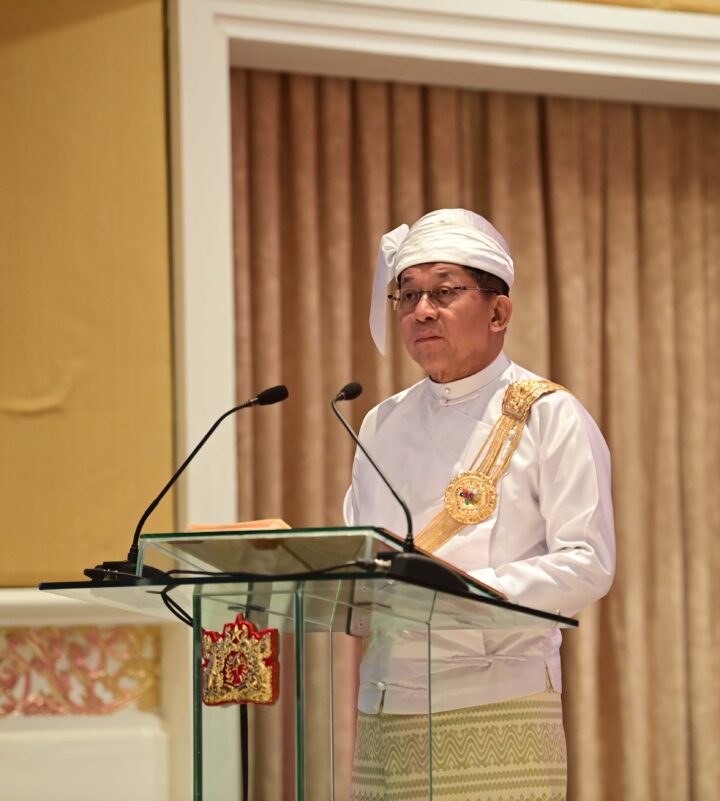
Everybody, Mingalaba!
I would like to extend greetings to the Vice-Presidents, State-level officials, and members of the Union Government who are about to assume State responsibilities following the formation of the new democratic government, as well as to the Chief Ministers of the Region and State Governments attending online, and to all those present here. May you all be blessed with physical and mental well-being, and I extend my best wishes that you may carry out the interests of the nation and its people with renewed and greater efforts.
On 3 April, the Pyidaungsu Hluttaw elected and appointed me as the President of the State and also appointed the Vice-Presidents. Accordingly, in accordance with the (2008) Constitution of the Republic of the Union of Myanmar, I have scrutinized, selected, and appointed the heads and members of Union-level organizations, as well as the Union Ministries, Union Ministers, Deputy Ministers, and the Chief Ministers and Ministers of the Regions and States for the Union Government. Therefore, as our new government proceeds with its duties, I will now outline the necessary policies and the tasks that must be implemented moving forward.
As is well known, due to a failure to properly assess alleged electoral fraud in the 2020 multiparty democratic general election, and driven by what were considered erroneous ideologies and interference from domestic and foreign elements, riots and violence erupted across the country. Taking advantage of this unrest, certain ethnic armed organizations with malicious intent further escalated the situation, employing various means of destruction that contributed to national instability. Despite these difficulties and challenges, Tatmadaw has made efforts to hold elections and has sought to place the country back on the path to democracy.
Looking back at our history, it is widely recognized that the primary reasons for the loss of independence, the long period of colonial rule, and the lack of stability and peace since independence have been the weakness of national unity among ourselves. Therefore, I would like to emphasize and urge continued efforts with a focus on ethnic solidarity and lasting peace.
I will personally ensure that the Nationwide Ceasefire Agreement (NCA) process continues to be implemented without fail. It is essential to recognize and accept that resolving disagreements, demands, and grievances through armed conflict is entirely unacceptable. For the sake of the country and its people, these mistakes must be corrected promptly to secure the nation’s future. Instead of demanding what one “wants”, it is necessary to focus on what is “appropriate” and to prioritize what is “achievable.” If we rebuild with unity and solidarity, I am confident that we will reach the new nation we envision, with stability and peace, in the very near future.
Similarly, I would like to urge ethnic armed groups and those committing acts of violence to carefully consider right and wrong, good and bad, and benefit and harm, and to cooperate for the sake of the nation and its people. I also extend an invitation to all parties to seek solutions through dialogue and negotiation, and to work together in harmony to build a new nation with renewed strength and unity.
On the other hand, we are striving through various means to elevate the nation’s economy, education, healthcare, and social sectors, and to ensure national development. If a country’s economic strength is not robust and the nation is not wealthy, development is impossible, and the socioeconomic lives of the people will remain poor. The national economy is interconnected with politics, security, and social affairs. Therefore, we need to work together to implement measures that will transform our nation into an economically developed one. When comparing our country’s GDP to others in the region, it is found to be very low. The primary cause is weak productivity. It has been observed that, for a long time, there has been a reliance on non-trade income. Therefore, we must promote high-standard manufacturing; since exports can only be generated through the production of export-quality goods, we must encourage and implement quality production processes.
Our country is based on agriculture and livestock. Therefore, we must develop agro-based industries rooted in these sectors.
In this regard, some critics question why we are not transitioning into an industrial nation in this modern era. However, over 70 per cent of Myanmar’s population resides in rural areas, and approximately 50 per cent are employed in agriculture, livestock, fisheries, and forestry. Women make up 53 per cent of the nation’s population, and according to educational surveys, those living in rural areas face certain disadvantages. Furthermore, World Bank reports indicate that the poverty rate in Myanmar stands at 31 per cent. Therefore, we must inevitably work towards boosting the rural economy.
Throughout our tenure, we have encouraged and promoted micro, small and medium enterprises (MSMEs) based on agriculture and livestock, organizing regional and national-level exhibitions and competitions annually. As a result, MSME businesses have flourished and achieved success over the five-year term. Since a solid foundation has now been established, I urge you to work towards achieving continuous and accelerated growth during the term of the new government. To facilitate this, the Ministry of Industry has been reorganized under the new government as the Ministry of Industry and MSME Development. Therefore, I would like to urge you to promote the MSME sector in all respects.
It is essential to cultivate paddy, which is vital for food security, across all farmland to achieve target yields. I urge you to strive not only to ensure domestic self-sufficiency but also to regain our former status as a major rice exporter in the region. Similarly, I encourage you to work with the ambition that “the era of Myanmar Pawsan rice must rise again”. Another key priority is to expand the cultivation of oilseed crops such as groundnut, sesame, soybean and sunflower to achieve domestic edible oil sufficiency.
Therefore, it is necessary to effectively promote the cultivation of soybean, sunflower and sesame, as these crops can make a significant contribution among oilseed varieties. In the cultivation of sesame and sunflower, the simultaneous practice of beekeeping to support pollination can improve pollination rates and increase yields. At the same time, this would enable honey production and provide additional benefits to farmers; therefore, I urge you to adopt beekeeping as a complementary activity.
Furthermore, it is necessary to expand the cultivation of industrial raw material crops such as rubber, cotton and bamboo. If we can produce high-quality rubber domestically, it will increase foreign exchange earnings and help meet the demand for a wide range of domestic consumer goods. We should also manufacture finished rubber-based products such as motorcycle tyres, bicycle tyres and tubes, rubber boots, and other consumer items. Similarly, the cotton-based industry is one of the most reliable and promising sectors in our country. Given that there are approximately 524,000 acres of cotton plantations, I would like to emphasize that, by effectively cultivating high-quality long-staple cotton and promoting cotton-based industries such as raw cotton, yarn and textiles, substantial benefits can be achieved.
Likewise, it is necessary to focus on bamboo-based industries. It is estimated that Myanmar can produce and utilize over 300 million bamboo stalks annually. Between 200,000 and 400,000 tonnes of various types of paper are imported each year, and with over two million tonnes imported between 2018 and 2025, more than US$2 billion have been spent. Therefore, it is essential to make effective use of bamboo grown in Myanmar, which is a primary raw material for paper production. Bamboo is not only useful for basic needs such as food, clothing and shelter, but can also be used to produce industrial raw materials such as pulp and bamboo fibre. At the very least, we must work towards domestic pulp production. Similarly, there is a large global market for coffee. In general, both highland coffee (Arabica) and lowland coffee (Robusta) grow well across Myanmar. Therefore, we should promote coffee cultivation in both lowland and highland regions, according to the varieties best suited to each area.
To elevate the agricultural sector, it is essential to strengthen the key inputs – namely seeds, soil, water and technology – and to transition towards scientific and mechanized farming systems. At present, some countries have already integrated AI into their agricultural practices. Therefore, only by moving from traditional methods to systematic and mechanized farming can we boost domestic productivity. To achieve this, we are promoting the innovation and manufacture of locally produced agricultural machinery through MSMEs. To support mechanized farming, it is necessary to restart domestic factories that have been suspended for various reasons, and to encourage the expansion of production in both state-owned and private factories. In line with the motto, “Let us promote production to make the nation prosperous,” I urge you to work towards comprehensive development across all economic sectors.
As mentioned earlier, because we are not producing to our full capacity or in line with our potential, there is currently an imbalance between supply and demand. Consequently, the need to import a large proportion of goods has contributed to higher commodity prices. Similarly, in the livestock sector, including layers, broilers and commercial pig farming, it is evident that the ratio between current livestock numbers and the size of the consuming population remains disproportionate.
Regarding animal feed, raw materials such as bran, broken rice and maize are produced in abundance across the country, and there is significant potential to manufacture feed from other inputs such as bean cake, sesame cake and fishmeal. If we import only the necessary veterinary medicines and additives, and utilize domestic resources for the remaining inputs, this approach will be both beneficial and effective.
Since agriculture and livestock rearing are fundamental to all citizens and pivotal to the national economy, I would like to emphasize that the points I have mentioned should be effectively implemented in practice. The reason our goals have not yet been fully achieved, and why shortcomings remain, is that approximately 70 per cent of the population living in rural areas has not been able to carry out agriculture and livestock rearing systematically and comprehensively. Furthermore, the remaining 30 per cent of the population living in urban areas has not provided sufficient support to production sectors. Therefore, under the new government, I wish to emphasize the need to analyze these issues, develop agricultural and livestock experts and professionals, and supervise their work closely to ensure practical success and effectiveness.
To achieve economic development and ensure the well-being of our citizens in meeting their basic needs, it is essential to have adequate infrastructure, including reliable transport, access to electricity, and a supply of clean water. The electricity sector is fundamental to both national development and economic growth. Therefore, we must prioritize strengthening the electricity sector, which remains underdeveloped in our country.
To ensure access to electricity, it is also necessary to implement solar power systems that are suitable for our country. While solar systems have been successfully adopted in many countries, they remain significantly underdeveloped in ours. In the central part of our country, we receive full sunlight for approximately 300 days a year. Even in the high-rainfall regions of Lower Myanmar, we receive sunlight for about 250 days. Therefore, if we can transition to using solar power systems for applications ranging from household use to commercial enterprises, industrial operations, and river-water pumping for agriculture, it would greatly supplement our power requirements. Additionally, this would reduce the demand for imported fuel used in generators, thereby helping us save foreign currency expenditure.
Likewise, it is necessary to enhance the transport sector to ensure convenient travel for the public and facilitate the smooth and efficient movement of goods. Only then can logistics be streamlined and rising commodity prices reduced. Under current circumstances, it is essential to adhere to established policies and regulations regarding the conservation of fuel and petroleum, an issue faced both internationally and within our own country. I would like to urge an increase in the use of rail transport for both passengers and freight, as well as arrangements to promote the use of electric vehicles (EVs) as alternatives to vehicles running on petrol and diesel.
In the transport sector, it is essential to upgrade the railway system, as it enables large-scale capacity and the rapid, cost-effective movement of goods and passengers. It is necessary to improve the tracks while also modernizing locomotives and rolling stock. We must prioritize the domestic production of these locomotives and carriages. By transitioning from current fuel-powered locomotives – an effort already underway – to battery-powered alternatives, we can reduce fuel consumption, minimize environmental impact, and improve overall speed and efficiency. Therefore, I would like to urge efforts to strengthen the railway sector for both passenger and freight transport, ensuring it becomes more efficient, beneficial, and a reliable service for the public.
To build our country into a developed democratic Union, we require a large number of capable and highly skilled human resources, including intellectuals and technical experts. A nation cannot be built without a strong foundation of education and knowledge. Therefore, as is well known, throughout our tenure, we have worked to develop the education sector in a comprehensive manner. Since the promotion of education is not a short-term task but a continuous process, I would like to urge you to remain consistently and steadfastly focused on this effort.
At one time, our country’s education system met international standards. However, as the education sector subsequently declined, we are now working to restore and enhance it. Young people are the future of the nation, its strength, and those who will build the country. Therefore, we must promote the youth sector. Strengthening this sector requires generational progress and change, which takes time. This is why it is essential to establish a systematic and solid foundation from the outset.
In promoting education, merely being literate, passing grade levels, obtaining a degree, or becoming a subject matter expert is not sufficient. However, literacy and formal education are fundamental requirements. Furthermore, one can only be truly regarded as “educated” when they possess the wisdom appropriate to their age and status – particularly in terms of mindset, outlook, critical thinking, and rationality. In other words, one must be proficient in both technical skills and intellectual wisdom.
To promote education, it is necessary to ensure that every school-aged child attends school, that dropout rates are reduced, and that students complete their studies. If educational standards are low, critical thinking and practical performance will likewise remain substandard. Therefore, I have established and am implementing a policy to ensure that everyone can study up to at least KG+9 level within the basic education sector. I urge parents, teachers, responsible officials and all citizens to understand and support this policy, and to work together for its successful implementation. If there are difficulties in pursuing higher education for various reasons, vocational high schools offering subjects such as mechanics, agriculture and livestock rearing have been established to support the agro-based industry. Thus, students will be able to acquire vocational skills at the secondary education level.
If we ensure that everyone is required to study up to KG+9 level, the number of students in schools will naturally increase. Accordingly, we must expand classrooms to meet demand based on student enrolment and appoint a sufficient number of teachers. I would like to emphasize that, for students to be happy at school and excel in their studies, school facilities must be well-maintained and in good condition, and teachers must possess high-quality teaching skills.
What we are seeing in the country today is that the majority of people have a limited understanding of existing laws or fail to respect them, resulting in a weakening of the rule of law. Only when all citizens know and follow the law can we achieve a disciplined, peaceful and prosperous society. Education and awareness of respect for the law must begin during school years. When education is weak, compliance with the law and the rule of law also tends to decline. For this reason, basic legal principles are being taught at the secondary education level in basic education schools, and we have expanded programmes to offer Bachelor of Arts (Law) degrees at various state and regional universities. Consequently, we can see that the rule of law has improved to some extent under current conditions. I would like to urge continued efforts to further strengthen its effectiveness during the term of the incoming government.
Regarding education, I would like to further emphasise that children who attend preschool before starting primary school are found to have a stronger foundation. While every preschool child eventually enters primary school, not every primary school pupil has had the opportunity to attend preschool. The key difference is that children with a preschool background tend to be more motivated to learn from the primary level onwards. Therefore, the relevant ministries must prioritise early childhood development in preschools. I would like to instruct you to focus on establishing effective preschools and prioritising Early Childhood Care and Development (ECCD). In line with the motto, “Let us encourage education for the nation’s development,” I urge you to work towards the comprehensive development of the entire education sector.
Along with education, we must also promote the healthcare sector. With the conviction that “nothing is more important than human life”, we have provided comprehensive support to upgrade the healthcare sector throughout our tenure, and we will continue to do so. No matter how educated or brilliant a person may be, if they are in poor health or physically impaired, they will not be able to work or contribute effectively. Therefore, I would like to instruct you to prioritize ensuring that all citizens are both mentally and physically healthy and fit.
In tandem with this, I would like to emphasize the promotion of the sports sector, which is closely linked to healthcare. It is necessary to revitalise our sports sector, which has been in decline in international competitions. Since sports range from general physical activity to the study and practice of a specific discipline one is passionate about, they greatly support health while also fostering discipline and morale. In line with the motto, “Promoting sports is defending the nation,” many countries encourage sports to enhance their national prestige. Likewise, I would like to instruct you to work towards the development and progress of our sports sector.
What I would like to further instruct is that we must prioritize environmental conservation, the cleanliness and beauty of rural areas, and the systematic development of urban centres. To achieve this, City Development Committees have been established in Nay Pyi Taw, Yangon and Mandalay, and Ministries of Development Affairs have already been formed in other regions and states. It is necessary to implement systematic town planning to ensure that cities and villages are easy to administer, clean and beautiful. Furthermore, we must systematically develop parks, sports fields and recreational areas where the public can rest, relax and engage in physical exercise.
As you are all aware, the world is currently warming and experiencing various natural disasters. Due to deforestation, we are suffering from extreme heat, and in some towns in Central Myanmar, temperatures have already risen so sharply that the elderly are being significantly affected. Therefore, it is necessary to establish cooling centres to provide immediate protection against the current heat. For the long term, I would like to instruct you to prioritise environmental conservation and tree planting in accordance with the motto: “Let us conserve the environment for the nation’s prosperity.”
At this moment, in accordance with the will of the people, we have returned to the path that the public desires. We have begun writing a new chapter in democracy – or, to put it another way, we are starting to draft its “second chapter”. Therefore, I would like to instruct that we work towards the national interest through coordination and consultation among the legislative, executive and judicial branches. We must resolve all future challenges through discussion and negotiation, working together in unity. As the saying goes, “A good start ensures a good end”; I urge everyone to act with restraint and care to ensure that we do not experience a reversal of progress as we did in the past.
I have formed the government under my leadership by selecting experienced individuals – those who are capable of prioritising the interests of the State and the people, and who possess genuine executive ability – with full trust and confidence. Learning from experience, we must strive to ensure “clean government and good governance”. We will work to achieve our objectives through cooperation between sector-specific Union Ministries at the central level and the regional and state governments. I would also like to instruct you to strive to the best of your physical and intellectual abilities to meet the needs of the people and the nation’s development, ensuring that there are no lapses or weaknesses, while fully adhering to legal procedures and regulations.
In the judicial sector, which is another major pillar, it is necessary to adjudicate cases accurately, correctly and swiftly, while acting with impartiality and strict adherence to the law. It is essential to impose appropriate sentences on those found guilty, while also ensuring that citizens receive the legal protection they rightfully deserve. I would like to instruct you to strive to make our court institutions that the public can rely on, and our judges individuals whom the people trust and respect. It is also necessary to ensure that all citizens enjoy equal rights before the law and to build a judicial pillar that is upright, honest and steadfast.
Another point is the need to ensure freedom from corruption. Corruption significantly hinders the development of the nation and undermines the character and morale of individuals. We must take preventive measures to ensure that malpractice does not become gradually entrenched, starting from the excuse of “drinking bitter water because everyone else is” and leading to widespread corruption. The key is for everyone, including members of the government, civil servants, entrepreneurs and all ethnic groups, to have the right mindset and good intentions. I would like to urge and instruct you to strive towards transforming and improving these mindsets.
In accordance with the oath we have taken before the Union Parliament, we must remain loyal and faithful to the Republic of the Union of Myanmar and its citizens. We must always uphold “Our Three National Causes”: non-disintegration of the Union, non-disintegration of national solidarity, and perpetuation of sovereignty. I would like to solemnly instruct that it is essential to prioritize the interests of the State and the people, to abide by and safeguard the Constitution of the Republic of the Union of Myanmar, and to carry out your duties with honesty and integrity.
We must gradually build the democratic transition process upon a solid and strong foundation. By taking lessons from the experiences of the past, I would like to urge and instruct all of us to work together in unison to continue successfully building a robust democratic nation with minimal flaws and weaknesses.
In conclusion:
– As members of our government, please fulfil the duties entrusted to you by the State and the people faithfully and dutifully.
– Prioritize the development of the nation and the socioeconomic advancement of its citizens.
– Study and analyze the lessons learned from the past to serve the interests of the country and the people effectively, swiftly, and correctly.
– Coordinate between the Union level and the various Regions and States to collaborate on the progress of all sectors, including politics, economy, education, and social affairs.
– In accordance with the will of the public, let us work together with a shared spirit to realize a new, modern, and developed democratic nation, adhering to our established objectives and goals.
With these exhortations, I conclude. Thank you all.
#TheGlobalNewLightOfMyanmar