
To reduce heavy foreign currency expenditure on imported edible oil, it is necessary to expand the cultivation of oilseed crops such as sunflower, soybean, and sesame, improve sunflower production, ensure affordable access to fertilizers, and provide maximum State support while encouraging farmers to maximize yields.
Acting President of the Republic of the Union of Myanmar and State Security and Peace Commission Chairman Senior General Min Aung Hlaing stated that to prevent increases in commodity prices caused by transportation costs, it is necessary to prioritize the use of public transport systems, such as railways, for the movement of goods.
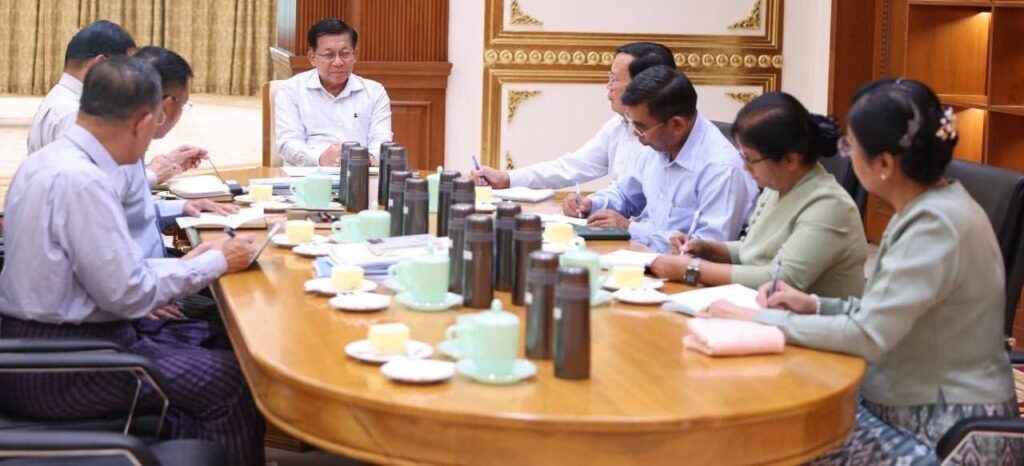
Senior General Min Aung Hlaing made the statement at a meeting on ensuring the availability of sufficient fuel and fertilizers for agricultural activities, held yesterday afternoon at the meeting hall of the Office of the National Defence and Security Council Chairman in Nay Pyi Taw.
He mentioned that, as the rail transport system reduces the cost of transporting goods, there is a need to expand freight train services and that relevant ministries and officials in regions and states should take steps to promote the wider use of rail transport for goods. And as fuel prices rise, commodity prices may also increase in line with transport costs. Therefore, the State is taking steps to ensure that diesel fuel, which is essential for public transport, can be purchased at affordable prices.
The Acting President also highlighted that, during this period of rising fuel prices and a slight increase in the US dollar exchange rate – driven by higher spending on fuel and other imported goods – efforts should be made to prevent increases in domestic prices, particularly for low-income groups and employees, including reducing taxes on imported fuel and giving priority to diesel, which is primarily used in public transport, when importing fuel.
He continued to say that, with the onset of the hot and dry summer season, the use of air conditioners has increased, leading to higher electricity consumption and more frequent use of generators, and emphasized that, alongside the need to conserve electricity, reducing generator fuel and vehicle usage can help decrease fuel consumption and foreign exchange expenditure, while the import of electric vehicles (EVs) should be implemented through a system that allows old fuel-powered vehicles to be surrendered in exchange for EVs.
The Acting President and State Security and Peace Commission Chairman also discussed that, just as agricultural activities require inputs such as water and fertilizers and equipment such as tractors and water pumps depend on fuel, it is necessary to implement solar-powered electric pumping systems to reduce fuel consumption, while, in light of rising fuel and fertilizer prices, the use of chemical fertilizers should be reduced in favour of natural alternatives, with subsidies provided to make essential fertilizers more affordable, tax collection minimized, and a continued focus on ensuring the food security of the people.
He stated that, since domestic edible oil is imported every year to meet local demand, resulting in significant foreign currency expenditure, it is necessary to expand the cultivation of oilseed crops such as sunflower, soybean, and sesame, and that further improvements in sunflower production would reduce the need for imports and lower foreign exchange spending, while also emphasizing that fertilizers essential for farmers should be made available at affordable prices, with the State providing maximum support and farmers striving to maximize production.
He also noted that, due to current conflicts in the Middle East, the world is facing a fuel shortage, and Myanmar is making efforts to address this challenge by implementing an odd-even rotation system for vehicles and motorcycles and QR code-based oil refuelling, as well as allowing government offices and departments to work from home every Wednesday to reduce domestic fuel consumption further.
The attendees then discussed ongoing efforts to import fuel to address the domestic shortage, measures to ensure a sufficient supply of fuel for public transport, including railways, ships, and buses, and steps to guarantee an adequate supply of fertilizers for agricultural activities.
Afterwards, Acting President and State Security and Peace Commission Chairman Senior General Min Aung Hlaing guided discussions on the reports and subsequently adjourned the meeting.
The meeting was attended by Prime Minister U Nyo Saw, Commission Member U Aung Lin Dwe, Commission Secretary and Commander-in-Chief of Defence Services General Ye Win Oo, Union Minister for Home Affairs Lt-Gen Phone Myat, Union Minister for Finance and Revenue Dr Kan Zaw, Union Auditor-General Dr Khin Naing Oo, and Central Bank of Myanmar Governor Daw Than Than Swe.
MNA/TH
#TheGlobalNewLightOfMyanmar